All camps

Westerbork

Westerbork transit camp

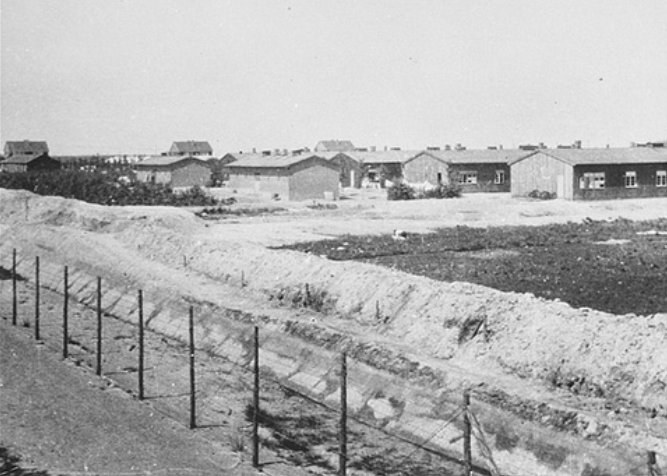
The Westerbork transit camp in the occupied Netherlands.

Westerbork transit camp. Public domain.

Type
Transit Camp
Location
Near Westerbork and Assen, Drenthe province, Netherlands
Operational dates
Established as a refugee camp October 1939; a German transit camp from July 1942 to April 1945
Liberation
12 April 1945, by Canadian forces, who found 876 inmates remainingThe Germans abandoned the camp in early April 1945; the last deportation transport had left on 13 September 1944.
Approximate prisoner count
More than 100,000 Jews passed through; the Germans deported approximately 100,000 people via the camp between July 1942 and September 1944
Approximate death toll
Deaths at the camp itself were comparatively low; the overwhelming majority were murdered after deportation, most at Auschwitz-Birkenau (over 55,000) and Sobibor (34,313), with smaller numbers to Theresienstadt and Bergen-Belsen. Only about 5,000 of those who passed through survived.Westerbork was a holding and dispatch point, not a killing site; the deaths are attributable to the destinations above. The ~5,000 survivors reflect post-deportation fate, not camp mortality.
Primary prisoner categories
Almost entirely Jews, initially German-Jewish refugees and later the broad Jewish population of the occupied Netherlands. A small number of Roma were also deported. A long-term resident population of about 2,000 was eventually deported as well.
Commandants
Albert Konrad Gemmeker was the longest-serving commandant (October 1942 to April 1945); he was sentenced at his 1949 Dutch trial to ten years, served about six, and a later West German investigation was closed in 1976 without prosecution. (Earlier commandants Erich Deppner and Josef Hugo Dischner have no clean Holocaust conviction reliably established.)

Westerbork sat in the flat, sandy countryside of Drenthe in the northeastern Netherlands, near the German border and far from Amsterdam, and for most of the occupation it was the place from which the deportation trains left. Begun by the Dutch in 1939 to shelter German-Jewish refugees, it was seized by the Germans in July 1942 and turned into the transit camp from which Dutch Jewry was funneled east. Transports left on a relentless schedule, twice weekly at first and then every Tuesday, bound mostly for Auschwitz-Birkenau and Sobibor, with smaller numbers to Theresienstadt and Bergen-Belsen. Few died at Westerbork itself; almost everyone passed through it on the way to somewhere worse. More than 100,000 people were deported through its gates, and only about 5,000 of them survived the war.
The people of Westerbork

Anne Frank

1929 to 1945

Diarist who passed through Westerbork before deportation.

Annelies Marie Frank was born on 12 June 1929 in Frankfurt am Main, and her family hid in a concealed annex in Amsterdam from July 1942. After the hiding place was discovered on 4 August 1944, the eight occupants were sent to Westerbork and then deported to Auschwitz-Birkenau on 3 September 1944 in a transport of 1,019 people, the last transport from Westerbork to Auschwitz. Anne and her sister Margot were later moved to Bergen-Belsen, where both died of disease in early 1945, shortly before liberation. Her diary, preserved by the helper Miep Gies and published by her father Otto, the family's sole survivor, became one of the most widely read accounts of the Holocaust.

Read more: What a Handwritten Signature Unlocked for Me

Etty Hillesum

1914 to 1943

Writer interned at Westerbork.

Esther 'Etty' Hillesum was born on 15 January 1914 in Middelburg and was a Dutch-Jewish writer whose diaries and letters, published posthumously, are among the most important personal testimonies of the period. She took an administrative post with the Jewish Council that allowed her to move between Amsterdam and Westerbork, then became an internee at the camp herself, from where she wrote letters that survive as an important record of the camp. She was deported with her family on 7 September 1943 and died at Auschwitz on 30 November 1943. As her train pulled away she threw out a postcard that was found and posted by farmers, saying she had left 'singing.'

Jules Schelvis

1921 to 2016

Sobibor survivor and historian who passed through Westerbork.

Jules Schelvis was born on 7 January 1921 in Amsterdam and was a Dutch printer who became a survivor and pioneering historian of the Sobibor killing center. He spent six days at Westerbork before deportation on the transport of 1 June 1943, which carried 3,006 people and reached Sobibor on 3 June; he was the only known survivor of that transport, spared selection and routed through a series of other camps. After the war he devoted decades to documenting Sobibor, authoring a landmark history of the camp and testifying at war-crimes trials, including the 2011 Demjanjuk trial in Munich. He died in 2016.

Albert Konrad Gemmeker

1907 to 1982

SS commandant of Westerbork.

Albert Konrad Gemmeker was born on 27 September 1907 in Düsseldorf and served as commandant of Westerbork from October 1942 until April 1945, the camp's longest-serving and best-documented commandant. Under his administration the great majority of the roughly 100,000 deportees were dispatched east on the weekly transports, the destinations set in Berlin but the selection of who boarded made at the camp. He was tried in the Netherlands in 1949, sentenced to ten years, and released after serving roughly six; a later West German investigation was closed in 1976 without prosecution, and he died in 1982.

Subcamps

None. Westerbork operated as a single transit-camp site within the wider Dutch deportation system; the Herzogenbusch (Vught) concentration camp was a separate camp, not a subcamp of Westerbork.

Researched and written by · Fortitude Research

Work with Erin

Tell me who
you are looking for.

Start the search About Erin