All camps

Treblinka

Treblinka

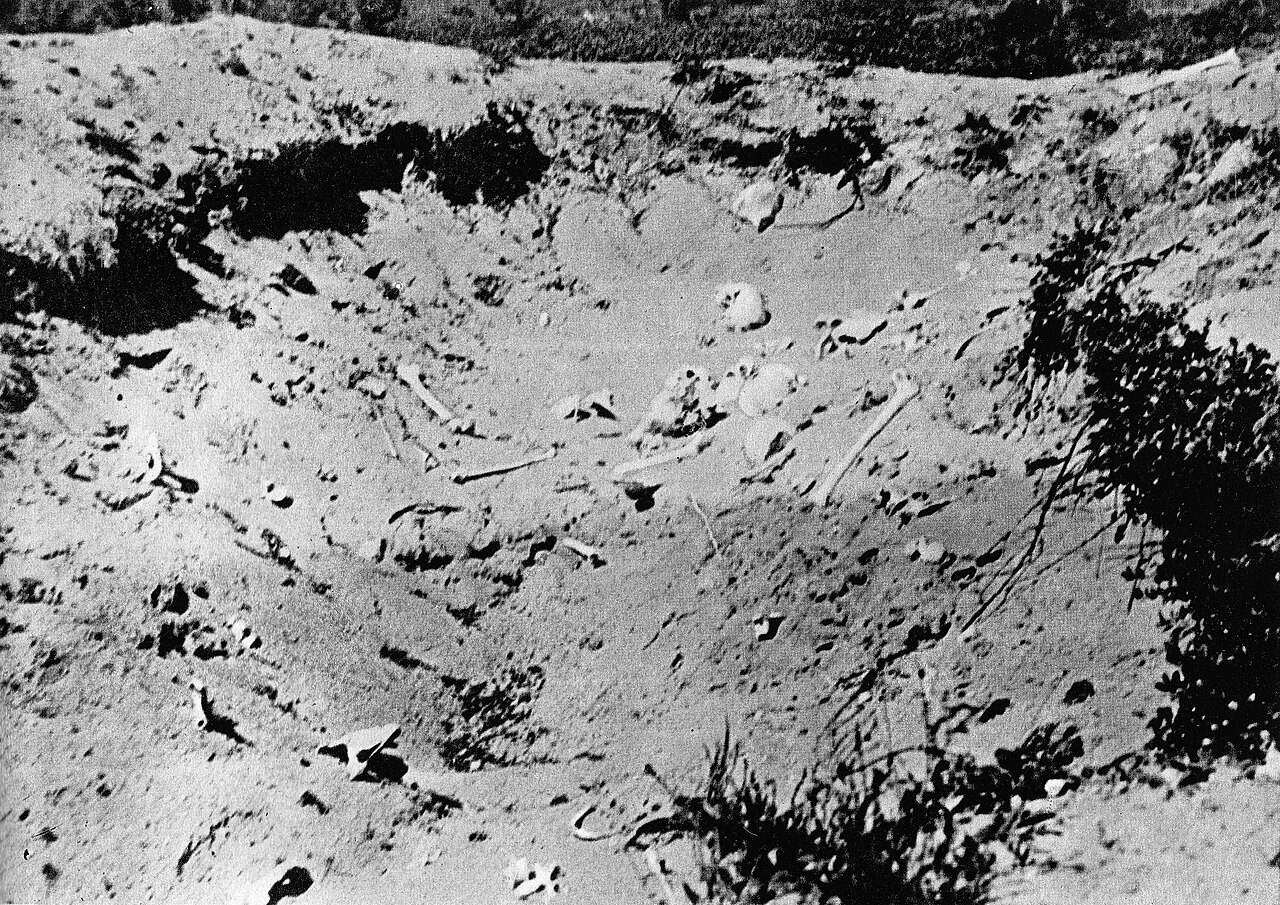
The Treblinka site in the summer of 1945, after the SS had dismantled and ploughed over the killing center.

Treblinka, 1945. Public domain.

Type
Extermination Camp
Location
Near Wólka Okrąglik, northeast of Warsaw, German-occupied Poland
Operational dates
Killing center (Treblinka II) operational July 1942 to autumn 1943; the separate Treblinka I labor camp operated 1941 to July 1944
Liberation
Dismantled before liberationThe SS dismantled and ploughed over the killing center in autumn 1943 after the August 1943 revolt; Soviet troops reached the disguised site only in late July 1944.
Approximate prisoner count
A killing center, not a holding camp; the relevant figure is the number deported there. Only a small forced-labor detachment was kept alive at any time.
Approximate death toll
An estimated 925,000 Jews, plus an unknown number of Poles, Roma, and Soviet POWsBecause the camp was destroyed and almost no records survive, totals are reconstructed from deportation records and testimony; scholarly estimates range roughly 700,000 to 900,000 and above.
Primary prisoner categories
Overwhelmingly Jews, from the Warsaw ghetto (about 265,000), the Radom District (about 346,000), the Białystok District (over 110,000), and the Lublin District, plus Jews from Theresienstadt and from Bulgarian-occupied Thrace and Macedonia, and smaller groups from Germany, Austria, France, and Slovakia. Also an undetermined number of Roma and Poles.
Commandants
Irmfried Eberl, the first commandant (July to August 1942), was dismissed for mismanagement and died by suicide in 1948 while awaiting trial. Franz Stangl (1942 to 1943) fled postwar, was extradited from Brazil, convicted at the Düsseldorf Treblinka trial in 1970, and died in prison in 1971; his successor Kurt Franz was sentenced to life in 1965 and released in 1993.

Treblinka was built in occupied Poland for one purpose, and for a little over a year it served that purpose on a scale second only to Auschwitz. It stood in a thinly populated, wooded area northeast of Warsaw, reached by a rail spur from the Małkinia junction, and it was operated by a small German staff of roughly 25 to 35, supported by Trawniki-trained auxiliary guards. As the third killing center of Operation Reinhard, after Belzec and Sobibor, it was designed chiefly to murder the Jews of the Warsaw and Radom districts, and an estimated 925,000 Jews died there along with unknown numbers of Poles, Roma, and Soviet prisoners of war. The site was elaborately camouflaged, with a fake railway station meant to deceive arriving deportees. On 2 August 1943, prisoners staged an armed revolt and burned much of the camp; in its aftermath the SS dismantled the site, ploughed it over, and installed a farmer to hide what had happened there.
The people of Treblinka

Samuel Willenberg

1923 to 2016

Survivor and artist; took part in the revolt.

Samuel Willenberg was born on 16 February 1923 in Częstochowa, Poland, and was deported to Treblinka in 1942, where he was selected from an incoming transport for the forced-labor detachment. He took part in the prisoner revolt of 2 August 1943 and was among the roughly two to three hundred prisoners who broke out, sustaining a leg wound as he escaped. After the war he settled in Israel, and decades later he created a series of bronze sculptures depicting scenes from the camp, exhibited as a lasting memorial. At his death in Israel on 19 February 2016, aged ninety-three, he was the last known living survivor of the Treblinka uprising.

Jankiel Wiernik

1889 to 1972

Survivor and chronicler.

Jankiel Wiernik was a Polish-Jewish carpenter, born around 1889, who was deported to Treblinka on 23 August 1942 during the great deportation from the Warsaw ghetto. His skill as a carpenter led the SS to use him on construction work throughout the camp, giving him unusual knowledge of its layout. He escaped during the revolt of 2 August 1943, reached Warsaw, and wrote one of the earliest detailed eyewitness accounts of the killing center, circulated clandestinely in 1944. His testimony was later used as evidence, and in 1961 he testified at the trial of Adolf Eichmann in Jerusalem; he emigrated to Israel, where he died in 1972.

Chil Rajchman

1914 to 2004

Survivor and chronicler.

Chil Rajchman was born on 14 June 1914 in Łódź and was deported to Treblinka in October 1942, where he was forced to labor in the prisoner detachment. He escaped during the revolt of 2 August 1943 and survived in hiding, where he wrote a detailed account in Yiddish recounting what he had witnessed. After the war he emigrated, by way of France, to Montevideo, Uruguay, where his account was first published in Spanish in 1997. He died in Montevideo in 2004; the account he had written in hiding was published after the war.

Franz Stangl

1908 to 1971

SS commandant of Treblinka.

Franz Paul Stangl was born on 26 March 1908 in Altmünster, Austria, and had served in the T4 'euthanasia' program before being made the first commandant of Sobibor in 1942 and then commandant of Treblinka from September 1942. After the war he fled via Italy to Brazil, where he lived openly for some sixteen years until his arrest in 1967 and extradition to West Germany. He was convicted at the Düsseldorf Treblinka trial in 1970 and sentenced to life imprisonment, dying in prison in June 1971.

Subcamps

Treblinka had no subcamps in the usual sense; it consisted of two adjacent but administratively separate installations, Treblinka I (a forced-labor camp around a gravel pit) and Treblinka II (the killing center).

Researched and written by · Fortitude Research

Work with Erin

Tell me who
you are looking for.

Start the search About Erin