Martin Niemöller
1892 to 1984
German pastor and prisoner; author of 'First they came...'.
Martin Niemöller was born in 1892 and commanded a U-boat in the First World War, earning the Iron Cross First Class, before being ordained a Protestant pastor in 1924. A national conservative who initially welcomed Hitler's 1933 accession, he turned against Nazi control of the churches as a leader of the Confessing Church. Arrested in 1937, he was held as Hitler's 'personal prisoner' in protective custody at Sachsenhausen and later Dachau from 1938 until 1945. He is best known for his postwar confessional statement beginning 'First they came for the socialists,' acknowledging the failure to resist Nazi persecution of successive groups. After the war he became a prominent pacifist and ecumenical leader and died in 1984.
Georg Elser
1903 to 1945
German carpenter and prisoner; would-be assassin of Hitler.
Johann Georg Elser was born on 4 January 1903, a skilled carpenter who, acting alone, built and concealed a bomb in a pillar of the Bürgerbräukeller in Munich to kill Hitler and other Nazi leaders on 8 November 1939. Hitler left earlier than expected and survived; the explosion killed eight people. Elser was arrested the same night attempting to cross into Switzerland and was held for more than five years as a special prisoner, in isolation at Sachsenhausen. He was moved to Dachau and killed there on 9 April 1945, weeks before the war's end. His meticulous solo plot has made him one of the most studied individual resisters of the era.
Also held at Dachau
Yakov Dzhugashvili
1907 to 1943
Soviet officer and prisoner; eldest son of Joseph Stalin.
Yakov Dzhugashvili, born in 1907, was the eldest son of Joseph Stalin and served as a lieutenant in a howitzer regiment when he was captured by German forces on 16 July 1941 during the fighting around Smolensk. After failed attempts to use him for propaganda, he was held at Oflag XC and then at Sachsenhausen. Following the German surrender at Stalingrad in early 1943, the Germans proposed exchanging him for Field Marshal Friedrich Paulus, an offer Stalin refused. Dzhugashvili died at Sachsenhausen on 14 April 1943.
Anton Kaindl
1902 to 1948
Last SS commandant of Sachsenhausen.
Anton Kaindl, born in 1902, became commandant of Sachsenhausen in 1942 and held the post until the camp's evacuation in April 1945. Captured by the Red Army, he was among sixteen defendants tried before a Soviet military tribunal in Berlin in the autumn of 1947. He was convicted and sentenced to life imprisonment, the USSR having abolished the death penalty in May 1947, and he died in Soviet captivity in 1948.
Hans von Dohnányi
1902 to 1945
German resistance jurist killed at the camp.
Hans von Dohnányi was a German lawyer and senior Abwehr official who used his position to aid the resistance against Hitler, including helping Jews escape Germany. Implicated alongside his brother-in-law, the theologian Dietrich Bonhoeffer, in the conspiracies against the regime, he was arrested in 1943. As Hitler ordered the remaining plotters destroyed, he was condemned by an SS court and killed at the main Sachsenhausen camp on 9 April 1945, weeks before liberation. He is remembered as one of the central legal minds of the German resistance.
August Dickmann
1910 to 1939
Jehovah's Witness conscientious objector, publicly executed.
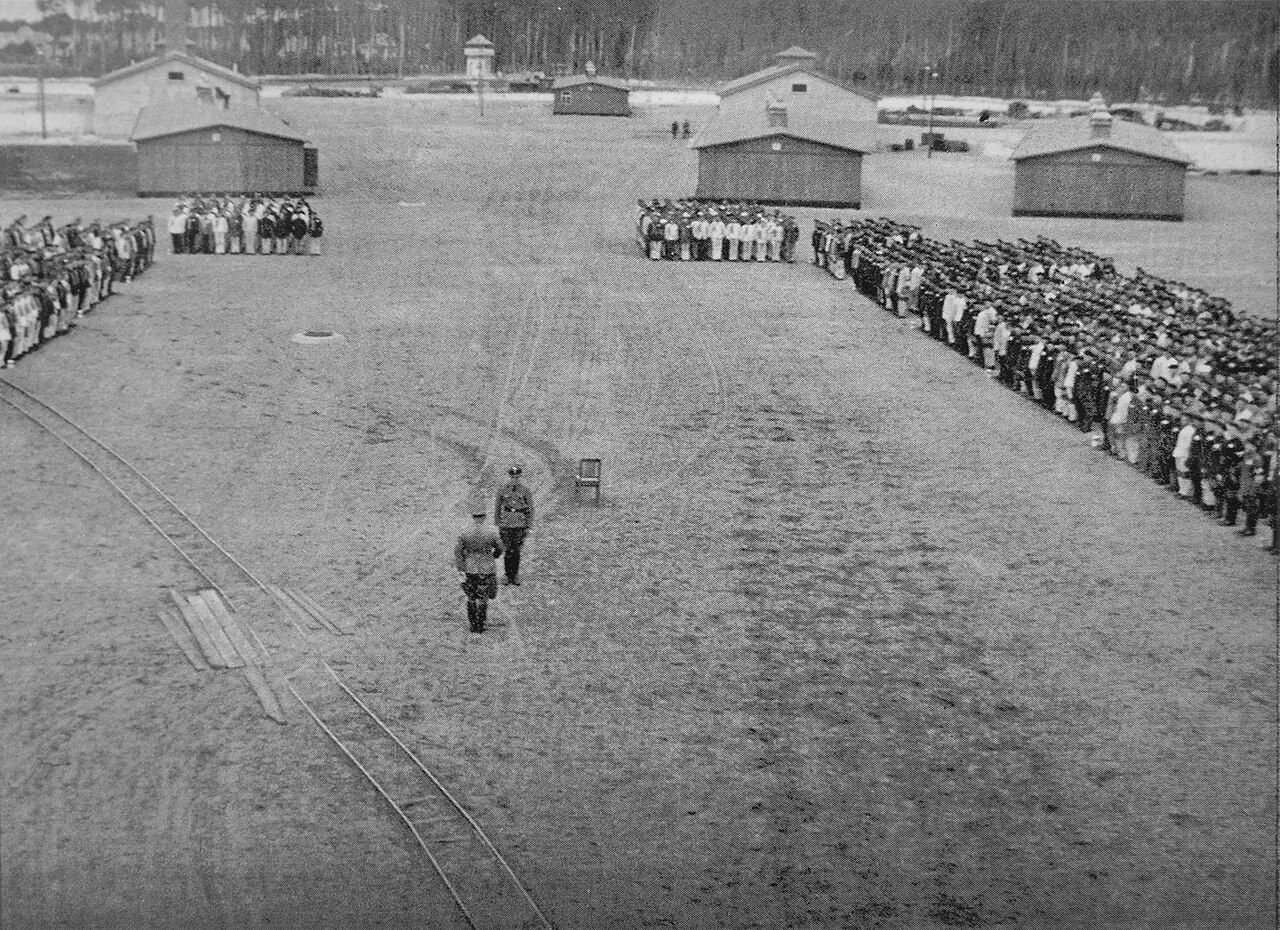
August Dickmann was a German Jehovah's Witness and conscientious objector imprisoned at Sachsenhausen who refused military service. When ordered to sign his draft papers in September 1939, he refused, saying he would never take up arms. On 15 September 1939 he was executed before the assembled prisoners, the first such execution at the camp. He is widely regarded as the first conscientious objector killed in the Second World War.
Francisco Largo Caballero
1869 to 1946
Former Spanish prime minister, interned at the camp.
Francisco Largo Caballero was a Spanish socialist and trade-union leader who served as prime minister of the Second Spanish Republic during the Civil War. After the Republican defeat he fled to France, where he was seized following the German occupation. In 1943, at the age of seventy-three, he was interned at the main Sachsenhausen camp, surviving in poor health until liberation in 1945. He returned to Paris and died there in 1946.
Paul Reynaud
1878 to 1966
Former French prime minister, held as a special prisoner.
Paul Reynaud was the French statesman who served as prime minister during the German invasion of 1940 and resigned rather than seek an armistice. Arrested by the Vichy regime and later handed to the Germans, he was held for a period in the special-prisoner section of the main Sachsenhausen camp before being moved on to captivity in the Tyrol. He survived the war, was liberated in 1945, and resumed a long career in French politics.
Adolf Burger
1917 to 2016
Slovak-Jewish typographer; survivor of Operation Bernhard.
Adolf Burger was a Slovak Jewish typographer deported through Auschwitz and then selected for Operation Bernhard, the Nazi scheme to forge British banknotes. In 1944 he was transferred to the main Sachsenhausen camp, where the counterfeiting unit worked in sealed barracks staffed by about 140 imprisoned specialists. He survived the war and spent decades as a witness documenting the operation and the Holocaust. He died in 2016 at the age of ninety-nine.
Herschel Grynszpan
1921 to unknown
His 1938 act was used to launch Kristallnacht; later held at the camp.
Herschel Grynszpan was a German-born Polish Jew who, in Paris in November 1938, assassinated the German diplomat Ernst vom Rath in protest at the deportation of his family; the Nazi regime seized on the killing as a pretext for the Kristallnacht pogrom. Handed to Germany after the fall of France, he was held as a special prisoner, including in the bunker at the main Sachsenhausen camp. His ultimate fate is unresolved: no death is documented, and he disappears from the record in the war's final years. He remains one of the most debated individuals of the prewar persecution.