All camps

Neuengamme

Neuengamme concentration camp

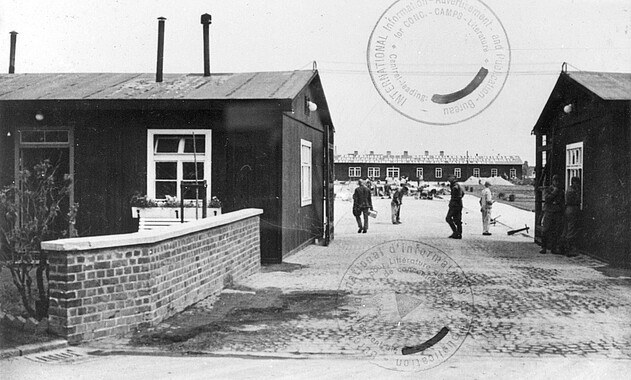
Entrance to the prisoner camp at Neuengamme; to either side stand the wooden barracks of the camp commander and the roll-call leader, with the roll-call area and kitchen barracks behind. SS photograph, 1941.

SS photograph, 1941. KZ-Gedenkstätte Neuengamme (ANg 1981-300).

Type
Concentration Camp
Location
Neuengamme, a suburb of Hamburg, northern Germany
Operational dates
December 1938 (founded as a Sachsenhausen subcamp; independent from June 1940) to early May 1945
Liberation
British forces arrived 4 May 1945; the SS had emptied the camp days earlierAbout 9,000 prisoners were marched toward Lübeck on 19 April 1945; British troops found the site essentially empty. Thousands of evacuated prisoners died on 3 May 1945 when British aircraft, unaware of those aboard, attacked the ships Cap Arcona and Thielbek.
Approximate prisoner count
Approximately 104,000 to 106,000 people were imprisoned from 1938 to 1945, about 13,500 of them women
Approximate death toll
More than 50,000 prisoners, almost half of all those imprisoned there, died in the Neuengamme systemApproximate. The total combines registered camp deaths with an estimate for the chaotic final week, the death marches, and the ship sinkings, which cannot be precisely counted.
Primary prisoner categories
Prisoners were drawn from across occupied Europe, the largest groups Soviet, Polish, French, German, Dutch, Danish, and Belgian. Jewish prisoners were few at first; from 1944 Polish and Hungarian Jews were transferred in, with some 13,000 Jews held in total. The camp was also a site of medical experiments, including tuberculosis experiments on twenty Jewish children.
Commandants
Walter Eisfeld was the first commandant (from 1938; he died in 1940). Max Pauly was the final and longest-serving commandant, from September 1942 until liberation; he was convicted at the British Curiohaus trial in Hamburg in 1946 and executed at Hameln prison on 8 October 1946.

Neuengamme was established by the SS in December 1938 on the grounds of a disused brickworks in a suburb of Hamburg, first as a satellite of Sachsenhausen and from June 1940 as an independent concentration camp. Its prisoners came overwhelmingly from German-occupied Europe and were worked in the brickworks, in river and canal projects, in armaments plants, and in the perilous clearing of rubble and unexploded ordnance from bombed northern German cities. The camp became the hub of a large network of subcamps spread across northern and central Germany, with more than twenty in Hamburg alone. It was also a site of lethal medical experiments, most infamously the tuberculosis experiments on twenty Jewish children who were murdered at the Bullenhuser Damm school in April 1945. By war's end more than 50,000 of those imprisoned at Neuengamme had died.
The people of Neuengamme

Jacqueline Morgenstern

1932 to 1945

French Jewish child; victim of medical experiments.

Jacqueline Morgenstern was born on 26 May 1932 in Paris, the daughter of a hairdresser. After the family was arrested and held at Drancy, she was deported to Auschwitz, arriving on 23 May 1944, and was transferred to Neuengamme on 28 November 1944 as one of twenty Jewish children selected for tuberculosis experiments. On 20 April 1945 she was killed with the other children at the Bullenhuser Damm school in Hamburg, aged twelve. The memorial at Bullenhuser Damm keeps the names and faces of all twenty children.

Rémy Dumoncel

1888 to 1945

French publisher, mayor, and resistance member.

Rémy Dumoncel was born on 28 October 1888 in Romorantin and was a French publisher at the Tallandier house in Paris and, from 1935, the mayor of Avon, a town about thirty-five miles southeast of Paris. Under the occupation he remained mayor and joined the resistance group Vélite-Thermopyles, using his office to shelter Jews, provide false papers, and help fugitives reach the unoccupied zone. He was arrested in Avon by the Gestapo on 4 May 1944. He was deported to Neuengamme, where he died on 15 March 1945.

Kurt Heissmeyer

1905 to 1967

SS physician who conducted experiments at Neuengamme.

Kurt Heissmeyer was a German physician and lung-disease specialist, born on 26 December 1905, who was authorized by Heinrich Himmler to conduct tuberculosis experiments at Neuengamme. In 1944 his subjects were twenty Jewish children transferred from Auschwitz, and to conceal the crime the SS killed the children and their caregivers at the Bullenhuser Damm school in April 1945. After the war he resumed medical practice in Magdeburg, in East Germany, and was not arrested until December 1963. A Magdeburg court sentenced him to life imprisonment in 1966, and he died in prison in 1967.

Max Pauly

1907 to 1946

SS commandant of Neuengamme, 1942 to 1945.

Max Pauly was born on 1 June 1907 in Wesselburen and commanded Stutthof from 1939 to August 1942 before becoming commandant of Neuengamme and its subcamps in September 1942, a post he held until liberation, living on the camp site with his family. He was tried by a British military court at the Curiohaus in Hamburg in the spring of 1946 and sentenced to death with eleven other defendants. He was hanged at Hameln prison on 8 October 1946, and was never tried for the crimes committed at Stutthof.

Also a commandant at Stutthof

Subcamps

The SS established approximately 80 subcamps across northern and central Germany between 1942 and 1945, with more than 20 in Hamburg alone. Well-documented ones include Drütte (Watenstedt-Salzgitter), Bremen-Farge, Wöbbelin, Bullenhuser Damm, Hamburg-Neugraben, Hamburg-Sasel, Hannover-Stöcken, and Salzgitter-Bad, among others.

Researched and written by · Fortitude Research

Work with Erin

Tell me who
you are looking for.

Start the search About Erin