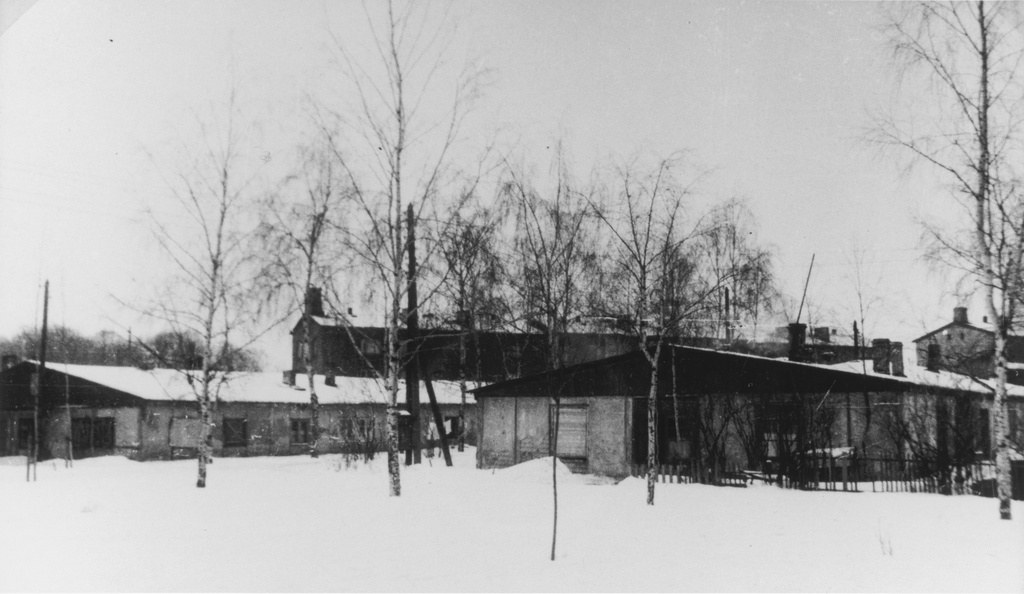
The Riga-Kaiserwald camp in winter, its barracks standing among the birches.
Staatsanwaltschaft beim Landgericht Hamburg; provenance Josef Schneider, file 141 Js 534/60, photo 48.
- Type
- Concentration Camp
- Location
- Mezaparks (Kaiserwald), a northern suburb of Riga, German-occupied Latvia (Reichskommissariat Ostland)
- Operational dates
- 15 March 1943 to autumn 1944
- Liberation
- Evacuated and liquidated in summer 1944; the site was taken by the Red Army on 15 October 1944From August 1944 the SS shipped surviving prisoners by sea to Stutthof; those judged unable to make the journey were killed beforehand.
- Approximate prisoner count
- By March 1944 the camp and its subcamps held 11,878 prisoners (6,182 men and 5,696 women), almost all of them Jews
- Approximate death toll
- An aggregate death toll for the camp is not reliably establishedDeaths came from forced labor and harsh conditions and from the killing of prisoners judged unfit during the 1944 evacuation; the 1941 Rumbula massacre figures belong to the earlier ghetto phase, not to this camp.
- Primary prisoner categories
- Overwhelmingly Jews. After the Riga, Liepaja, and Daugavpils ghettos were destroyed in 1943, the surviving Jews of Latvia and most survivors of the Vilna ghetto were concentrated here; from 1944, Hungarian Jews and Jews from Lodz were also sent. A small number of non-Jewish prisoners and several hundred German convicts, the camp's first inmates, were also held. The camp anchored a network of forced-labor subcamps around Riga.
- Commandants
- Albert Sauer, who had served in the SS camp system at Sachsenhausen and Mauthausen, commanded Kaiserwald from its founding in March 1943 and was never tried, dying of wounds in May 1945. (Eduard Roschmann, the so-called 'Butcher of Riga,' commanded the Riga Ghetto rather than Kaiserwald, despite a popular conflation drawn from fiction.)
Konzentrationslager Riga-Kaiserwald was the principal SS concentration camp in the occupied Baltic, opened in March 1943 in a wooded suburb on the north edge of Riga. When the Nazis destroyed the ghettos of Riga, Liepaja, and Daugavpils that June, the surviving Jews of Latvia, soon joined by survivors of the Vilna ghetto and, later, Jewish prisoners from Hungary and Lodz, were concentrated here under the SS camp administration. Kaiserwald was not a killing center but a hub of forced labor, governing a wide network of subcamps around Riga whose prisoners were leased to German firms, most prominently the electrical conglomerate AEG. By March 1944 nearly 11,900 prisoners were held in the camp and its satellites. As the Red Army pressed into Latvia in the summer of 1944, the SS dissolved the camp and shipped the survivors by sea to Stutthof, leaving the site to be occupied by Soviet forces that October.
Subcamps
The camp anchored a network of forced-labor subcamps around Riga, among them Strasdenhof (the AEG works), Balastdamm, Dunawerke, Spilve, Lenta, Muhlgraben, the army motor-vehicle park (HKP), and the railway detail, with further satellite sites in Riga and in Courland such as Dundaga.