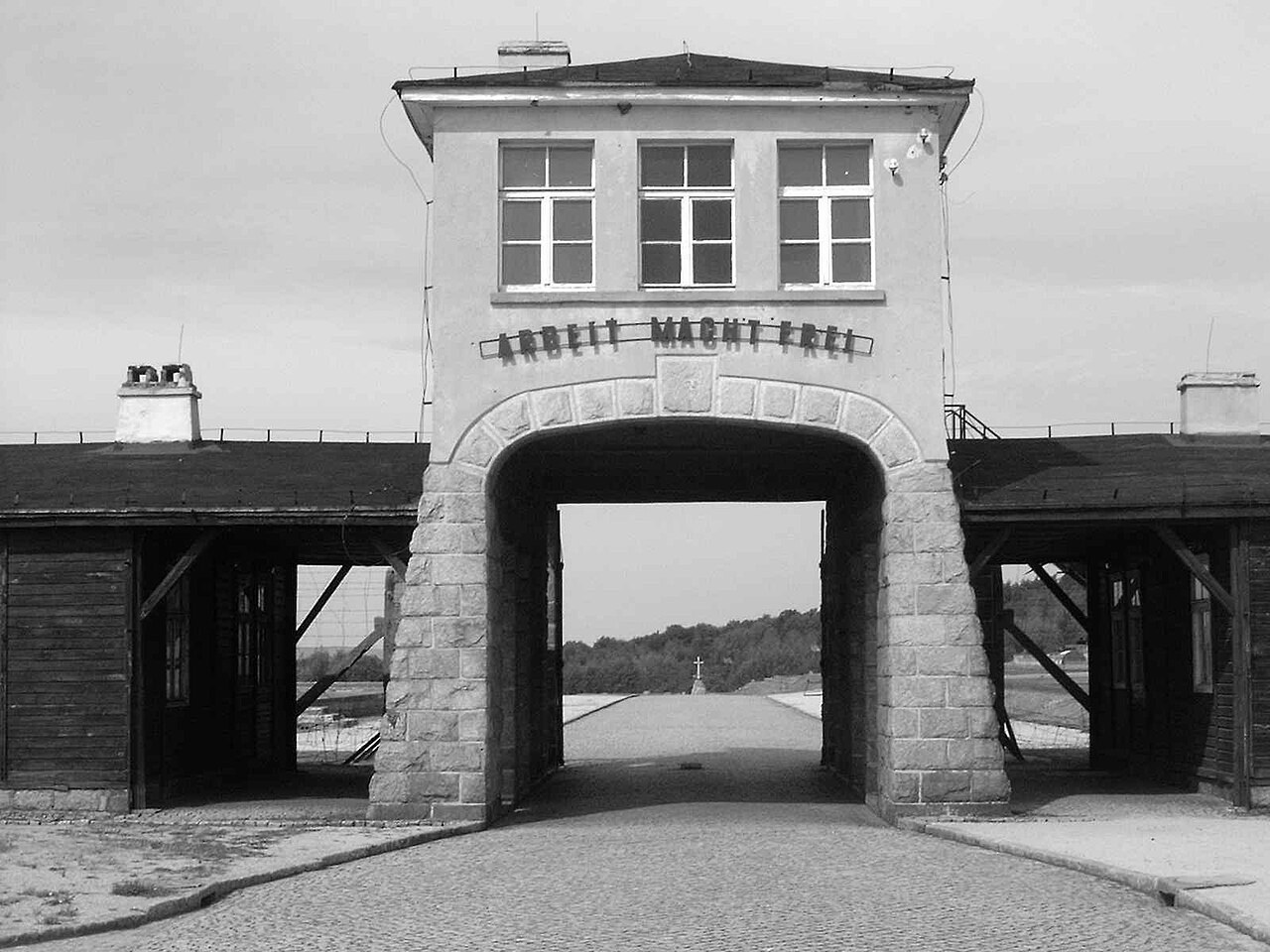
The preserved gatehouse at the Gross-Rosen Memorial, bearing the 'Arbeit macht frei' sign, with the memorial cross beyond.
Gross-Rosen Memorial, Rogoźnica.
- Type
- Concentration Camp
- Location
- Gross-Rosen (now Rogoźnica), Lower Silesia (then eastern Germany, now southwestern Poland)
- Operational dates
- 1940 (founded as a Sachsenhausen subcamp; autonomous from 1941) to 13 February 1945
- Liberation
- 13 February 1945, by Soviet forces (the main camp)The Germans had largely evacuated the complex ahead of the Soviet advance; at least 44,000 prisoners were sent westward under brutal conditions before the main camp was reached.
- Approximate prisoner count
- An estimated 120,000 prisoners passed through the system; on 1 January 1945 it held 76,728, nearly 26,000 of them women
- Approximate death toll
- At least 40,000 prisoners died, either in Gross-Rosen or during the evacuationEstimated minimum. The figure spans the main camp, the large subcamp network, and the deadly winter evacuations of early 1945, which cannot be precisely tallied.
- Primary prisoner categories
- Early prisoners were used as forced labor in the camp's construction and granite quarry. From late 1943 a mass influx of Jews, as many as 60,000 by January 1945, reshaped the population, many arriving via the Organisation Schmelt labor camps and, later, the evacuation of Auschwitz. The complex held an unusually large number of female prisoners, most of them Jewish.
- Commandants
- Arthur Rödl was commandant from May 1941 to September 1942; he was not brought to trial and died by suicide in spring 1945. (Later commandants included Wilhelm Gideon and Johannes Hassebroek.)
Gross-Rosen was established in 1940 in Lower Silesia, near the village that gave it its name (today Rogoźnica in southwestern Poland), at first as a subcamp of Sachsenhausen and from 1941 as an independent camp built around an SS-owned granite quarry. Its early prisoners labored in the quarry under lethal conditions, but as the war economy demanded more forced labor the camp grew into the administrative center of a vast network of at least 97 subcamps serving firms such as Krupp, IG Farben, and Daimler-Benz. From late 1943 tens of thousands of Jews were deported into the system, including an exceptionally large population of Jewish women, and in early 1945 prisoners from the evacuation of Auschwitz passed through as well. As Soviet forces approached in January 1945 the Germans evacuated the complex westward in brutal winter transports before the main camp was liberated on 13 February 1945.
Subcamps
The complex administered at least 97 subcamps across Silesia and beyond, supplying forced labor to major German firms. They included Aslau, Bad Charlottenbrunn, Bad Warmbrunn, Bernsdorf, Birnbäumel, Bolkenhain, the Breslau camps, Brünnlitz, Buchwald-Hohenwiese, Bunzlau, Christianstadt, Dörnhau, Dyhernfurth, Falkenberg, Faulbrück, Freiburg, Friedland, Fünfteichen, Gabersdorf, Gebhardsdorf, Gräben, Görlitz, Grünberg, Halbau, Halbstadt, Hartmannsdorf, Hausdorf, Hirschberg, Kaltwasser, Kamenz, Kittlitztreben, Kratzau, Kurzbach, Landeshut, Langenbielau, Liebau, Ludwigsdorf, Märzdorf, Markstädt, Mittelsteine, Namslau, Neusalz, Ober Altstadt, Parschnitz, Peterswaldau, Reichenbach, Sackisch, Schertendorf, Schmiedeberg, Schlesiersee, Striegau, Schweidnitz, Tannhausen, Trautenau, Waldenburg, Weisswasser, Wolfsberg, Wüstegiersdorf, and Wüstewaltersdorf, among others.