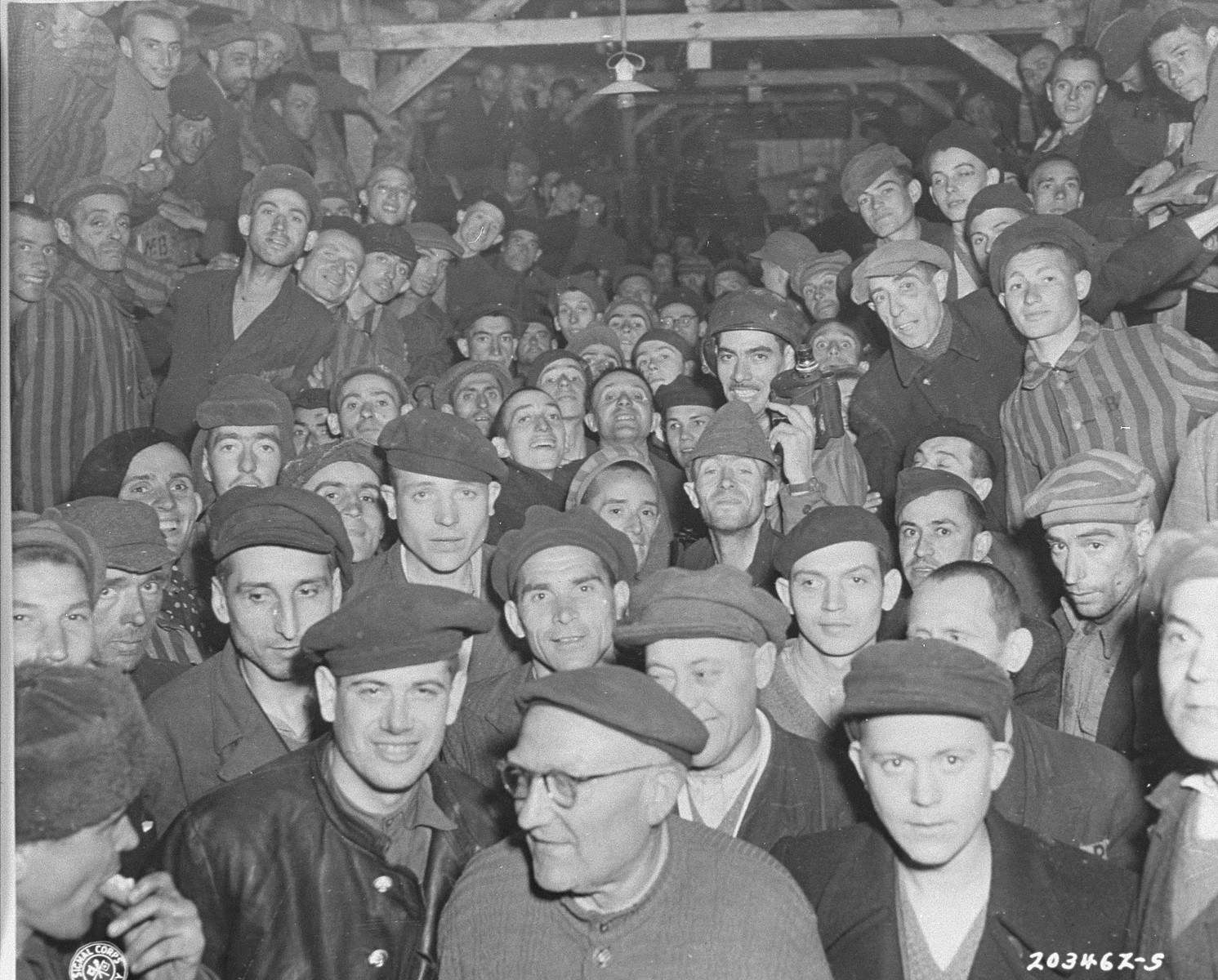
Elie Wiesel
1928 to 2016
Survivor; author of Night; Nobel Peace Prize laureate.
Eliezer Wiesel was born on 30 September 1928 in Sighet, then in Hungarian-administered Transylvania and today part of Romania. In May 1944 he and his family were deported to Auschwitz, where his mother and younger sister were murdered; he and his father were later sent on to Buchenwald. He was among the prisoners liberated by the U.S. Third Army on 11 April 1945 and appears in the well-known U.S. Army photograph of the Little Camp barracks. He became an author and human-rights advocate whose testimony reached readers worldwide, was awarded the Nobel Peace Prize in 1986, and died in 2016.
Imre Kertész
1929 to 2016
Survivor; Hungarian writer and Nobel laureate in Literature.
Imre Kertész was born on 9 November 1929 in Budapest. In 1944, aged fourteen, he was deported with other Hungarian Jews to Auschwitz and was subsequently sent to Buchenwald, where he was liberated in 1945 before returning to Budapest. He drew on that experience in a body of literature centered on the camps and received the Nobel Prize in Literature in 2002, the first Hungarian to do so. He died in 2016.
Jorge Semprún
1923 to 2011
Survivor; Spanish writer and statesman.
Jorge Semprún was born in Madrid on 10 December 1923 and went into exile in Paris in 1937 during the Spanish Civil War, later studying philosophy at the Sorbonne. He joined the communist resistance and was arrested by the Gestapo in 1943; in early 1944 he was deported to Buchenwald as a 'Spanish political' prisoner, where his fluency in German shaped his vantage on camp life. He was liberated there on 11 April 1945. He drew on the experience in his postwar writing and later served as Spain's Minister of Culture from 1988 to 1991. He died in 2011.
Ernst Thälmann
1886 to 1944
Prisoner; former chairman of the Communist Party of Germany.
Ernst Thälmann was born on 16 April 1886 in Hamburg and led the Communist Party of Germany from 1925 until the Nazi seizure of power. He was arrested on 3 March 1933 and held in detention for more than eleven years, much of it in isolation. On 18 August 1944 the SS killed him at Buchenwald, where he had been brought after years of imprisonment elsewhere. He became one of the most prominent political victims associated with the camp.
Léon Blum
1872 to 1950
Special prisoner; former Prime Minister of France.
Léon Blum was a French statesman who in 1936 became the first Jewish and first socialist prime minister of France, at the head of the Popular Front government. Arrested under the Vichy regime and handed to the Germans, from 1943 he was held as a special prisoner at Buchenwald, housed in an isolated lodge outside the main inmate compound under strict but privileged conditions. In April 1945 he and other prominent detainees were evacuated south and freed by American forces in South Tyrol. He returned to French politics and briefly led the government again in 1946 and 1947.
Yisrael Meir Lau
born 1937
Child survivor; later Ashkenazi Chief Rabbi of Israel.
Yisrael Meir Lau was born in Piotrków Trybunalski, Poland, the son of the town's chief rabbi, who was murdered at Treblinka. Deported as a young boy, he was imprisoned at Buchenwald, where his survival is credited largely to his older brother Naphtali, who hid and protected him. He was among the youngest prisoners freed when American forces liberated the main camp on 11 April 1945, aged seven. He emigrated to Mandatory Palestine that summer and became one of Israel's most prominent religious figures, serving as Ashkenazi Chief Rabbi and later as chairman of Yad Vashem.
Eugen Kogon
1903 to 1987
Survivor; compiler of the postwar Buchenwald Report.
Eugen Kogon was an Austrian-born Catholic sociologist and an early opponent of the Nazi Party, committed to Buchenwald as a political prisoner in 1939. He spent roughly six years there and worked as a clerk in the camp's typhus research station, a post he used to help save fellow prisoners by arranging identity swaps with inmates who had died. Immediately after liberation he led the former prisoners who produced the original Buchenwald Report for the U.S. Army. He went on to write the first major scholarly study of the concentration-camp system and became an influential intellectual in postwar West Germany.
Paul Schneider
1897 to 1939
Protestant pastor and martyr; 'the Preacher of Buchenwald'.
Paul Schneider was a German Protestant pastor and outspoken opponent of Nazi interference in the church. After repeated acts of defiance he was taken to Buchenwald in November 1937 and held largely in solitary confinement. From his cell he continued to call out words of scripture and encouragement to prisoners at roll call despite brutal reprisals, which earned him his name. He died at the main camp on 18 July 1939 and is widely regarded as the first Protestant minister martyred by the Nazi regime.
Princess Mafalda of Savoy
1902 to 1944
Italian princess; special prisoner who died at the camp.
Mafalda of Savoy was the second daughter of King Victor Emmanuel III of Italy and, by marriage, a landgravine of Hesse. After Italy broke with Germany in 1943, she was lured to the German embassy, arrested, and brought to Buchenwald that October, confined in the special compound for prominent detainees. She was injured during an Allied bombing of the camp's armament works in August 1944 and died of her injuries at the main camp on 28 August 1944.
James Hoyt
1925 to 2008
American liberator, 6th Armored Division, Third Army.
James Hoyt was a private first class in the U.S. Army's 6th Armored Division, part of Patton's Third Army, and a veteran of the Battle of the Bulge. On 11 April 1945 he drove the armored vehicle that carried a four-man reconnaissance team into Buchenwald, among the first American soldiers to reach the camp's roughly 21,000 surviving prisoners. He returned to Iowa and delivered rural mail for more than thirty years, long carrying what he had witnessed. At his death in 2008 he was the last survivor of that original team of liberators.