Anne Frank
1929 to 1945
Jewish diarist deported to Bergen-Belsen.
Annelies Marie Frank was born on 12 June 1929 in Frankfurt am Main, and her family fled to Amsterdam after the Nazis came to power. After two years hiding in a concealed annex, the family was discovered in August 1944 and deported, and Anne and her sister Margot were sent from Auschwitz to Bergen-Belsen in late 1944. She died at Bergen-Belsen in February or March 1945, weeks before the camp's liberation; the precise date is not established. Her father Otto was the family's sole survivor and published her diary in 1947, and it became the most widely read first-person account of the Holocaust era.
Read more: What a Handwritten Signature Unlocked for Me
Margot Frank
1926 to 1945
Jewish prisoner; Anne Frank's older sister.
Margot Betti Frank was born on 16 February 1926 in Frankfurt am Main, the elder daughter of Otto and Edith Frank. In July 1942 Margot received a summons ordering her to report for 'labor service,' the event that prompted the family to go into hiding in Amsterdam the following day. After the annex was discovered in August 1944, she was deported with Anne from Auschwitz to Bergen-Belsen, where she died in February or March 1945. As with Anne, the precise date of her death is not established.
Hanneli Goslar
1928 to 2022
Jewish survivor; childhood friend of Anne Frank.
Hannah Elisabeth Goslar was born on 12 November 1928 in Berlin; after the Nazis came to power her family moved to Amsterdam, where the Goslars lived near the Franks and Hannah and Anne became close friends. Arrested in 1943 and held at Westerbork, the family was deported to Bergen-Belsen, where Hannah was kept in a privileged 'star camp' section because the family held papers making them eligible for prisoner exchange. In early 1945 she spoke with Anne Frank through a barrier in the camp and tried to pass food to her, one of the last contacts with Anne before her death. Hannah survived, emigrated to what became Israel in 1947, worked as a nurse, and for decades testified to Anne's final months; she died on 28 October 2022.
Josef Kramer
1906 to 1945
SS commandant of Bergen-Belsen.
Josef Kramer became commandant of Bergen-Belsen in December 1944, having previously served in the SS camp system, including at Auschwitz-Birkenau, and was in command during the catastrophic final months when the population swelled and the death rate became overwhelming. In the autumn of 1945 he was among forty-eight Bergen-Belsen staff tried by a British military tribunal in Lüneburg and was one of eleven defendants sentenced to death. British military authorities executed him on 12 December 1945. The press nickname 'the Beast of Belsen' is a journalistic epithet rather than a documentary fact.
Also a commandant at Natzweiler-Struthof
Hadassah Bimko Rosensaft
1912 to 1997
Survivor-physician who organized prisoner care; witness at the Belsen Trial.
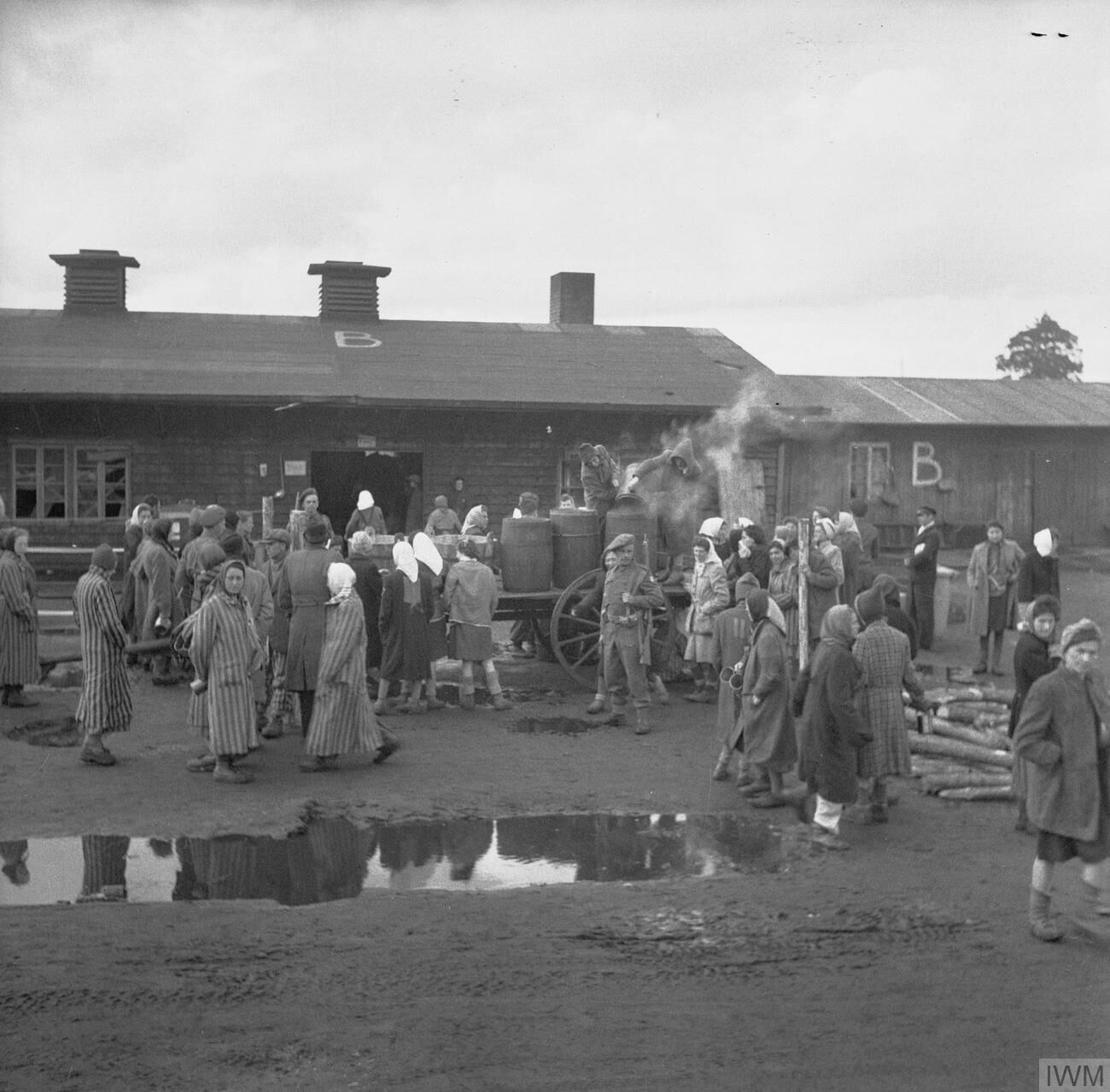
Hadassah Bimko was a dental surgeon from Sosnowiec, Poland, deported to Auschwitz-Birkenau in 1943, where her medical training helped keep her alive, and transferred to Bergen-Belsen in November 1944. Inside the camp she organized care for the sick and a refuge for orphaned children. After the British liberation on 15 April 1945 she led a team of survivor doctors and volunteers who worked alongside British medical staff to save thousands of critically ill prisoners. She testified at the 1945 Belsen Trial, identifying defendants including the commandant Josef Kramer, and afterward became a leading voice of the survivor community.
Anita Lasker-Wallfisch
born 1925
Cellist of the Auschwitz women's orchestra; Bergen-Belsen survivor.
Anita Lasker was born into a Jewish family in Breslau and was arrested by the Gestapo as a teenager before being sent to Auschwitz, where she survived in part because she played the cello in the camp's women's orchestra. In late 1944 she was transported to Bergen-Belsen, where she endured the catastrophic final months until the British Army arrived on 15 April 1945. After the war she settled in Britain and helped found the English Chamber Orchestra. In her later decades she became one of the most quietly authoritative living witnesses to the camps.
Josef Rosensaft
1911 to 1975
Survivor; leader of the Bergen-Belsen displaced-persons community.
Josef Rosensaft was a Polish Jew who survived a succession of camps before liberation. When Bergen-Belsen was freed in April 1945, survivors elected him to head the committee that represented them to the British authorities, and he went on to lead the Central Committee of Liberated Jews in the British Zone. He became the principal voice of the survivors at the Belsen displaced-persons camp and a determined advocate for Jewish refugees. He married the survivor-physician Hadassah Bimko.
Brigadier Glyn Hughes
1892 to 1973
Senior British medical officer at the liberation.
Hugh Llewellyn Glyn Hughes was the deputy director of medical services of the British Second Army and among the first Allied officers to enter Bergen-Belsen on 15 April 1945. He took charge of an unprecedented humanitarian emergency, directing the medical response for tens of thousands of starving and diseased survivors. He appointed the survivor-physician Hadassah Bimko to organize survivor medical teams and was a principal prosecution witness at the Belsen Trial. The survivors' hospital established near the site was named in his honor.
Richard Dimbleby
1913 to 1965
BBC war correspondent who reported from the liberated camp.
Richard Dimbleby was the BBC's first war correspondent. He entered Bergen-Belsen with British forces days after the liberation in April 1945 and recorded a dispatch describing what he found. His report was so harrowing that the BBC hesitated for several days, broadcasting it only after he threatened to resign, and it brought the reality of the camp home to the British public. He went on to become the BBC's leading broadcaster.
Chaim Herzog
1918 to 1997
British Army intelligence officer at the liberation; later President of Israel.
Born in Belfast and raised in Dublin as the son of Ireland's chief rabbi, Chaim Herzog emigrated to Mandatory Palestine in 1935 and served as a British Army intelligence officer during the war. In April 1945 he was present at the recently liberated Bergen-Belsen, where his work included identifying and questioning captured German personnel and helping gather evidence. He later became a major-general in the Israel Defense Forces and, in 1983, the sixth President of Israel. A memorial stone stands in his honor at the former camp.