All camps

Belzec

Belzec

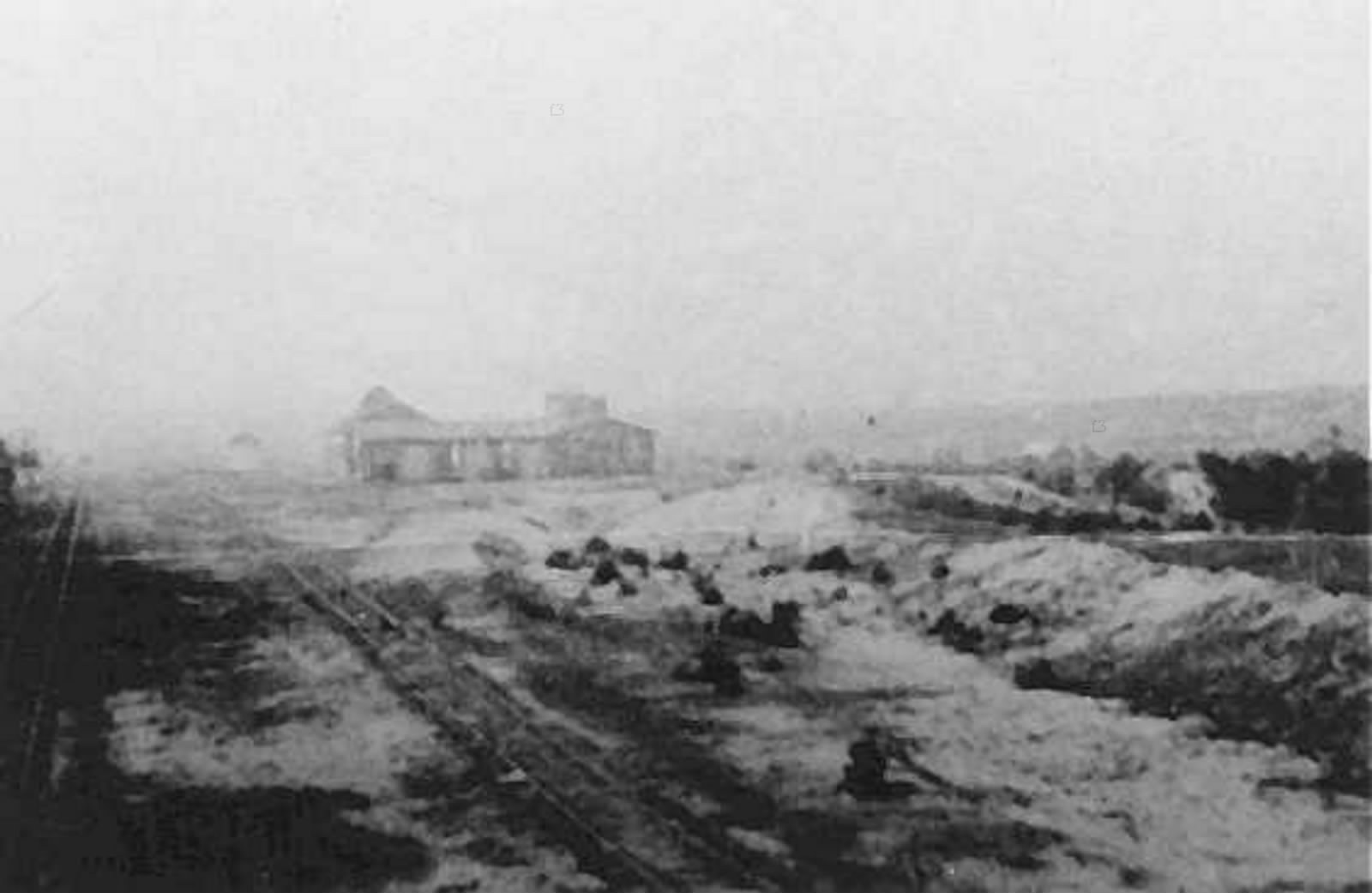
View after the obliteration of the Belzec extermination camp: the railway shed where victims' belongings were stored. Belzec, Poland, 1944.

Institute of Contemporary History and Wiener Library Limited; United States Holocaust Memorial Museum.

Type
Extermination Camp
Location
Near the village of Bełżec, Lublin District, German-occupied Poland (between Zamość and Lwów/Lviv)
Operational dates
Killing center operational 17 March 1942 to December 1942; site liquidated by June 1943
Liberation
Dismantled before liberationThe SS dismantled the camp by June 1943, ploughed it over, and built a farm to disguise the site; Soviet forces reached the area only in July 1944.
Approximate prisoner count
A killing center; the relevant figure is the number deported and murdered there. Only a small forced-labor detachment was kept alive at a time.
Approximate death toll
Approximately 434,500 Jews, plus an undetermined number of Poles and RomaUSHMM gives approximately 434,500, derived largely from a deciphered German railway message (the Höfle Telegram) and deportation records. With only two known survivors, the toll cannot be precisely verified; some estimates run higher.
Primary prisoner categories
Overwhelmingly Jews, mainly from the Galicia, Kraków, and Lublin districts of the General Government, including the major communities of Lwów and Lublin, plus German, Austrian, and Czech Jews routed through transit ghettos such as Izbica and Piaski. Also an undetermined number of Poles and Roma.
Commandants
Christian Wirth, the first commandant (1941 to 1942) and later Inspector of the Reinhard camps, was never tried; he was killed by Yugoslav partisans near Kozina, Istria, on 26 May 1944. Gottlieb Hering, the second and last commandant, was also never tried; he died in a hospital in October 1945.

Belzec was the first of the three Operation Reinhard killing centers to begin operations, and it became a model for the others. Built on the site of a former labor camp in the Lublin District, between Zamość and Lwów and chosen for its rail connections to regions with large Jewish populations, it was run by a small German staff of roughly 20 to 30 and a Trawniki-trained guard unit. In barely nine months of operation in 1942 the camp murdered approximately 434,500 Jews, mainly from the Galicia, Kraków, and Lublin districts, making it one of the deadliest sites of the Holocaust relative to its brief existence. Its first commandant, Christian Wirth, pioneered the killing operations later replicated at Sobibor and Treblinka. The camp was dismantled and disguised as a farm by mid-1943, and because only two prisoners are known to have survived, Belzec remains among the least documented and most haunting of the killing centers.
The people of Belzec

Rudolf Reder

1881 to 1977

Survivor and witness.

Rudolf Reder was born on 4 April 1881 and was one of only two known survivors of Belzec; deported from Lwów in August 1942, he was spared as a forced laborer and escaped in November 1942 while on a work detail in the city. In January 1946 he gave a detailed deposition to the Main Commission for the Investigation of German Crimes in Kraków. That same year, with the help of the Jewish Historical Committee, he published his account, illustrated with a map drawn by a fellow survivor. It remains the only substantial firsthand account of the camp's operation written by a surviving prisoner.

Chaim Hirszman

1912 to 1946

Survivor and witness.

Chaim Hirszman was born on 24 October 1912 in Janów Lubelski and was the only other known survivor of Belzec; deported there in 1942, he was selected for the forced-labor detachment. In May 1943 he escaped from a train transferring prisoners and joined a partisan group in the forests near Janów Lubelski. He began giving evidence to the Jewish Historical Commission in Lublin on 19 March 1946, but the same evening he was murdered at home by members of an armed group before he could complete his testimony. His widow continued his account the following day, so only a fragment of it survives.

Kurt Gerstein

1905 to 1945

SS officer and reluctant witness.

Kurt Gerstein, born in 1905, was an SS officer assigned to the Hygiene Institute of the Waffen-SS who was drawn into the implementation of the 'Final Solution.' On 17 August 1942 he was present at Belzec, where he witnessed the murder of a transport of Jews who had arrived by train from Lwów. He attempted to alert foreign diplomats, Vatican officials, and members of the German resistance to what he had seen. After the war he committed his account to writing in what became known as the Gerstein Report, later used as evidence at Nuremberg; he was found dead in his cell in French custody in Paris on 25 July 1945.

Christian Wirth

1885 to 1944

SS commandant of Belzec.

Christian Wirth was the first commandant of Belzec and a former operative of the T4 'euthanasia' program, experience that shaped his role at the camp. He was subsequently appointed Inspector of all three Operation Reinhard killing centers, the same supervisory role he had held for the earlier T4 facilities, and was replaced as Belzec commandant by Gottlieb Hering in 1942. He was killed by partisans in the Istria region in 1944 and never faced trial.

Subcamps

Belzec had no subcamps; it was a single killing center.

Researched and written by · Fortitude Research

Work with Erin

Tell me who
you are looking for.

Start the search About Erin